• Skip to main content
  • Skip to primary sidebar

Cognitive Computational Neuroscience

  • Home
    • CCN 2026 Organizers
    • Community Diversity, Equity, and Inclusion
    • Host a Future CCN Meeting
    • Privacy Policy
    • Code of Conduct
  • Account
    • Account Login
    • Create an Account
    • Account Home
  • Attend
    • Dates and Deadlines
    • Accommodations
    • Meeting Registration
    • Local Meetups
    • International Travelers
    • Travel Awards
    • Caregiver Awards
    • Local Food Options
    • Visit New York
    • Venue Information
  • Events
    • Schedule of Events
    • Community Events
    • Back2NY Event
    • Mind Matching
    • Community Networking Lunch
    • Transmitter Mentorship Program
    • Early-Career Faculty Social Lunch
    • Satellite Events
    • Social Event
    • Growing Up in Science
    • Distributed Bar Crawl
  • Presentations
    • Keynote Lectures
    • Keynotes & Tutorials
    • GACs
    • Contributed Talks
    • Poster Sessions
    • Search Papers
  • Submissions
    • Talk Presenter Instructions
    • Poster Presenter Instructions
    • Call for Papers
    • Call for Community Events
    • Call for GACs
    • Call for Keynotes & Tutorials
  • Sponsor
    • 2026 Sponsors
    • 2026 Exhibitors
    • Sponsorship Opportunities
  • Archive
    • CCN 2025
    • CCN 2024
    • CCN 2023
    • CCN 2022
    • CCN 2021
    • CCN 2020
    • CCN 2019
    • CCN 2018
    • CCN 2017
    • GACs
  • Contact Us

2026

Keynote Lecture: Kenji Doya

Keynote Lecture: Kenji Doya

Wednesday, August 5, 11:30 am – 12:30 pm, Skirball Theater

Play YouTube Recording

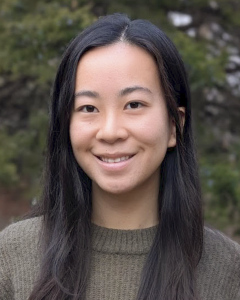
Kenji Doya, Okinawa Institute of Science and Technology Graduate University (OIST)
Professor of Neural Computation Unit

Kenji Doya is a Professor of Neural Computation Unit, Okinawa Institute of Science and Technology Graduate University (OIST). He studies reinforcement learning and probabilistic inference, and how they are realized in the brain. He took his PhD in 1991 at the University of Tokyo, worked as a postdoc at U. C. San Diego and the Salk Institute, and joined Advanced Telecommunications Research International (ATR) in 1994. In 2004, he was appointed as a Principal Investigator of the OIST Initial Research Project. As OIST established itself as a Graduate University in 2011, he became a Professor and served as the Vice Provost for Research till 2014. He served as Co-Editor in Chief of Neural Networks from 2008 to 2021, President of Japanese Neural Network Society (JNNS) from 2023 to 2024, and General Chair of Neuro2022 and ICONIP2025 in Okinawa. He received INNS Donald O. Hebb Award in 2018, JNNS Academic Award and APNNS Outstanding Achievement Award in 2019, and finished Ironman World Championship 2024 in Kona, Hawaii.

Presentation title: Neural circuits for prediction and action

Keynote Lecture: Brenden M. Lake

Keynote Lecture: Brenden M. Lake

Tuesday, August 4, 8:30 – 9:30 am, Skirball Theater

Play YouTube Recording

Brenden M. Lake, Princeton University
Associate Professor of Computer Science and Psychology

Brenden M. Lake is an Associate Professor of Computer Science and Psychology at Princeton University. He received his B.S. and M.S. in Symbolic Systems from Stanford University in 2009 and his Ph.D. in Cognitive Science from MIT in 2014. He was a postdoctoral Data Science Fellow at NYU from 2014–2017 and a faculty member there from 2017–2025.

Brenden is a recipient of the Robert J. Glushko Prize for Outstanding Doctoral Dissertation in Cognitive Science, an MIT Technology Review Innovator Under 35, and the author of research selected by Scientific American as one of the 10 most important advances of 2016. His research seeks the ingredients of intelligence: his lab uses advances in machine intelligence to better understand human intelligence, and insights from human cognition to develop more fruitful and capable forms of machine intelligence.

Presentation Title: Using advances in AI to address classic debates in cognitive science

Dates and Deadlines

Dates and Deadlines

Please Note: There will be NO DEADLINE EXTENSIONS! 
All deadlines are end of day AoE (Anywhere-On-Earth, UTC-12).

Date Deadline
January 5, 2026  8-page Paper Submissions Open (via OpenReview)
February 9, 2026 8-page Paper Submission Deadline for Abstracts (via OpenReview)
At this stage you have to provide us with metadata such as the title and summary
February 12, 2026 8-page Paper Submission Deadline for Full Papers (via OpenReview)
This is when you submit the full pdf version
February 14, 2026 GACs, Keynote & Tutorials, and Community Events Submissions Open
March 2, 2026 2-page Paper Submissions Open (via OpenReview)
March 31, 2026 GACs, Keynote & Tutorials, and Community Events Submission Deadline
April 2, 2026 2-page Paper Submissions Deadline (via OpenReview)
April 15, 2026 Registration Opens
April 30, 2026 Decisions Announced for GACs, K&Ts, and Community Events
May 28, 2026 Early Registration Deadline
June 1, 2026 Travel Award Deadline
June 1, 2026 Caregiver Award Deadline
June 1, 2026 Mentorship Program Application Deadline
July 15, 2026 Standard Registration Deadline
August 3-6, 2026
CCN 2026, New York University

Call for Papers

Call for Papers

8-page Paper Submissions open January 5.
The deadline for 8-page Abstracts is February 9 and the deadline for 8-page Full Papers is February 12.

2-page Paper Submissions open March 2.
The deadline for 2-page submissions is April 2.

See the Complete Submission Guidelines.

Two-track submission system

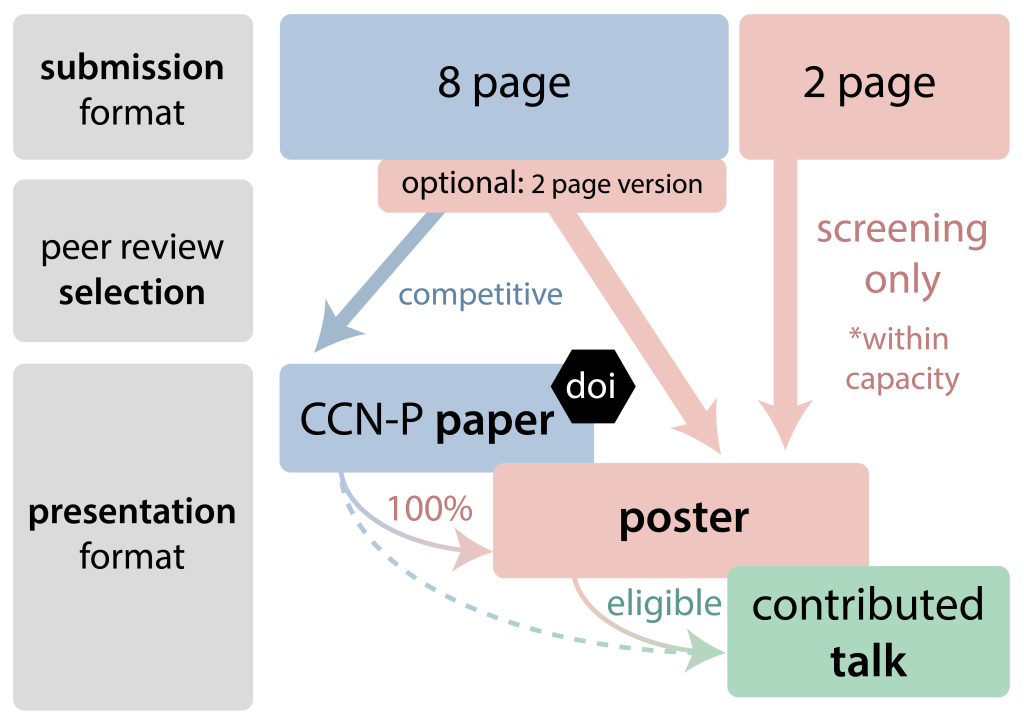
CCN 2026 will, once again, offer two submission tracks: 2-page Extended Abstracts (“2-pagers”) and 8-page Full Conference Papers (“8-pagers”). OpenReview will serve as the platform for submission of both types. 

2-pagers that align with the conference scope will generally be accepted, up to a maximum poster capacity. Accepted 2-pagers will be accessible through OpenReview

8-pagers will undergo competitive selection. Accepted papers will be published in the CCN Proceedings (CCN-P) with DOI assignment on OpenReview. You can view the CCN-P papers from 2025 in OpenReview. Authors of 8-pagers will have the option to submit a 2-page version of their work for consideration as a poster. Contributed talks will be selected from both accepted 8-pagers and 2-pagers, including the 8-pagers rerouted to 2-pagers

Figure 1. Submission Pathways for CCN 2026. The conference now offers two parallel tracks for submissions. The traditional extended abstract track (right) accepts 2-page submissions that meet scope and quality requirements for poster presentation, and are eligible for oral presentation selection. The new conference proceedings track (left) accepts 8-page submissions and implements a competitive acceptance rate, with accepted papers published with DOI in CCN Proceedings (CCN-P). All accepted papers in both tracks receive a poster presentation and are eligible for Contributed Talk selection. Submissions rejected by the CCN-P track are rerouted to the 2-page submission track for an acceptance decision (with another chance for oral presentation). 

Background on CCN's Conference Proceedings track

The introduction of a conference proceedings track is a response to our research community's needs. Traditional academic journals, while important for feedback and quality control, also introduce challenges including high costs and often lengthy publication timelines. While journals like PLoS Computational Biology, Cognitive Science, and eLife already offer some relief with lower costs of publishing and gold open access, machine learning conferences such as NeurIPS, ICLR, and ICML also demonstrate how conference proceedings with high peer review standards can foster rapid, affordable, and high-quality scientific communication.

CCN covers research at the intersection of AI, Neuroscience, and Cognitive Science. This convergence of fields presents a unique challenge and an opportunity to adopt publishing formats that resonate with researchers across these domains. We anticipate that the introduction of a long-form conference proceedings track, a format that has proven successful in the computer science and cognitive science communities, will benefit a substantial part of the researchers working at the intersection of these diverse fields. There is a lot of excitement and energy in the community, and we believe this new format will help us to, together, reach a higher standard of reviewing and editorial decisions, which will empower and democratize the CCN community.

In making this change, we've been careful to preserve what already works well. The traditional poster track, with its 2-page abstracts, remains unchanged, except that we will not be assigning DOIs to them. Parallel submission to other venues is allowed. This ensures that our existing community members continue to have the same opportunities for presentation and scientific exchange that have made CCN a valuable venue. The new proceedings track, therefore, complements but does not replace our established format, thereby enriching the conference's ability to serve our evolving research community.

Keynote Lectures

Keynotes | K&Ts | GACs | Talks | Posters | Search

Keynote Lectures

Doris Tsao

Representing the visual world: from faces to consciousness

Monday, August 3, 11:45 am – 12:45 pm, Skirball Theater

Brenden M. Lake

Using advances in AI to address classic debates in cognitive science

Tuesday, August 4, 8:30 – 9:30 am, Skirball Theater

Alona Fyshe

Can a (stochastic) parrot understand you? Contemplating intelligence in the era of LLMs

Wednesday, August 5, 8:30 – 9:30 am, Skirball Theater

Kenji Doya

Neural circuits for prediction and action
Wednesday, August 5, 11:30 am – 12:30 pm, Skirball Theater

Kalanit Grill-Spector

Understanding the functional neuroanatomy of the visual system using topographic deep neural networks and spatiotemporal receptive fields

Thursday, August 6, 9:30 – 10:30 am, Skirball Theater

Keynote & Tutorial – In silico neuroscience: an emerging paradigm for brain discovery

Keynote & Tutorial

Monday, August 3, 4:30 – 6:15 pm, Kimmel Center, Eisner & Lubin Auditorium

Play YouTube Recording

In silico neuroscience: an emerging paradigm for brain discovery

     
Alessandro Gifford1, Domenic Bersch2, Gemma Roig2, Radoslaw Cichy1, 1 Freie Universität Berlin, 2 Goethe Universität Frankfurt

Abstract

The functioning of the brain largely remains unsolved, partly because collecting in vivo neural data is slow and expensive, creating a bottleneck for brain experimentation and discovery. The emerging paradigm of in silico neuroscience addresses this limitation by leveraging encoding models of the brain, algorithms that predict neural responses to massive amounts of sensory stimuli in a fast and economical fashion. The scalability of in silico neural responses – which are used as stand-ins for in vivo neural responses during experimentation and data analysis – allows researchers to test more scientific hypotheses and to upscale exploratory research compared to experimenting on in vivo data. Crucially, novel findings from large-scale in silico experimentation are eventually validated in vivo, but with targeted small-scale data collection, therefore optimizing research resources and allowing for faster neuroscientific discovery. This keynote and tutorial advocates for this emerging research paradigm on theoretical, empirical, and methodological grounds. Theoretically, we will cover its advantages and limitations. Empirically, we will present recent work from our and other groups, where large-scale in silico experiments enabled discoveries that were then validated with targeted in vivo experiments. Methodologically, we will introduce the Brain Encoding Response Generator (BERG), a resource that we created consisting of pretrained encoding models of the brain and a Python package to facilitate researchers in the generation of in silico neural responses for visual and linguistic stimuli. Together, our goal is to excite interest in, and facilitate adoption of, this novel paradigm for brain discovery.

Tutorial Outline

The goal of the tutorial is to give participants hands-on experience with the emerging paradigm of in silico neuroscience, through three stages that logically progress into each other. In the first stage (~30 minutes), participants will learn how to use the Brain Encoding Response Generator (https://gifale95.github.io/BERG/) to generate in silico neural responses to visual stimuli using pre-trained encoding models of the brain. To establish the reliability of these in silico responses, in the second stage (~30 minutes) participants will experimentally show that they capture fundamental organizing principles of visual cortex, such as retinotopy or category selectivity. This will suggest that in silico responses also allow for scientific discovery. Thus, in the third stage (~45 minutes) participants will run large-scale experiments on in silico fMRI responses to explore visual selectivity across visual cortex, but also across underexplored cortical regions in vision neuroscience such as frontal areas. Throughout the tutorial, participants will actively make decisions such as which brain areas to investigate or which stimulus set to use, making the session highly interactive and experimental.

The tutorial will be accessible to researchers at all career stages with basic Python programming experience and a foundational understanding of fMRI data and regression-based statistical methods. Participants will implement in silico experiments through Google Colab notebooks in Python that run on the cloud without any software installation or data download, or locally as Jupyter notebooks. Although the tutorial will primarily focus on vision, the acquired experience naturally extends to other research domains within the CCN community such as language, audition, or motor planning, making the tutorial valuable to a diverse range of researchers interested in the emerging research paradigm of in silico neuroscience.

Link to Colab tutorial: https://colab.research.google.com/drive/1kXOzb5ivPNIk5izlqkHyCLaMz-0FqfSH?usp=sharing

Community Event – So You Have a Highly Predictive Model, Now What? Translating Neural Encoding Models into Scientific and Engineering Impact

Community Event

Wednesday, August 5, 4:00 – 5:45 pm, Skirball Theater

Play YouTube Recording

So You Have a Highly Predictive Model, Now What? Translating Neural Encoding Models into Scientific and Engineering Impact

   
Organizers: Jenelle Feather1, Maggie Henderson1, Jacob Prince2, 1 Carnegie Mellon University, 2 Harvard University


Event Speakers: Iris Groen1, Nicholas Lesica2, Thomas Naselaris3, Greta Tuckute4, Alex Williams5, Johannes Mehrer6, 1 University of Amsterdam, 2 University College London, 3 University of Minnesota, 4 Harvard University, 5 New York University, 6 EPFL

Abstract

“All models are wrong, but some are useful.” The field of cognitive computational neuroscience has focused intensely on addressing the first half of this aphorism, by compiling ever-larger neural and behavioral datasets and developing models that maximize predictive performance.  But the second half is rarely formalized: what does it mean for a predictive model to be scientifically useful?  As model performance saturates across many domains and modalities, and across diverse computational architectures, the field faces a key inflection point.  How should we best utilize models once they are “good enough”?

This community event will focus on the scientific and engineering applications of highly predictive models.  Speakers will present concrete examples of how encoding models have been used to support theory building, guide new experiments, implement causal interventions, or support translational engineering efforts such as BCIs and neural prosthetics. The discussion will then turn to a broader question: what infrastructure, benchmarks, and cultural norms does the field need to adopt in order to more effectively translate existing data and models into concrete scientific progress? By attempting to formalize what makes a predictive model useful, and articulating the set of pitfalls that currently impede that translation, this session aims to articulate a sharper roadmap for the next decade of modeling the brain.  

Session Plan

The event will open with a broad introductory talk by the organizers on neural encoding models, shared methodological foundations, and the current state of the field, providing the background needed for CCN attendees to engage with the session discussions. The event will then transition to short talks by a range of speakers who have utilized encoding models of the brain for scientific or engineering applications, followed by a panel discussion. Talks will highlight results where the speakers leveraged an encoding model to obtain new scientific insight, or, to pursue a translational application. The event will conclude with a moderated panel discussion on the future of the field, the desiderata the community might adopt for models that support these applications, and how best to harness the datasets and models already available.

Short talk titles: 
Iris Groen: Leveraging encoding models for scientific insight in human scene perception
Nicholas Lesica: Optimal hearing aid design through closed-loop neural restoration
Thomas Naselaris: Concept dose responses in human visual cortex
Greta Tuckute: Predicting, Controlling, and Interpreting Language Responses in the Human Brain
Alex Williams: Mechanistic Interpretability of Neurally Predictive Models
Johannes Mehrer: Toward model-guided visual prostheses and model-optimized dyslexia-friendly fonts

Keynote & Tutorial – Adaptive, degenerate, and yet comparable? Rethinking representational comparisons

Keynote & Tutorial

Monday, August 3, 4:30 – 6:15 pm, Skirball Theater

Play YouTube Recording

Adaptive, degenerate, and yet comparable? Rethinking representational comparisons

     
Erin Grant1, Lukas Braun2, Eleanor Holton3, Marvin Theiss4, 1 University of Alberta, 2 Allen Institute, 3 Princeton University, 4 University of Tübingen

Abstract

Comparing patterns of neural activity within and between biological and artificial systems has become a core methodology in neuroscience, psychology, and machine learning. Motivated by the goal of advancing our understanding of neural computation, representational comparisons are used to infer shared or divergent computations in minds and machines. However, neural network theory challenges the assumption that representational similarity generally provides a measure of computational similarity and vice versa. This tension arises from two defining features of biological and artificial neural networks: adaptivity and degeneracy. While internal representations are adapted to task demands and objectives, many distinct network configurations with distinct internal representations can implement the same behavior. Adaptivity therefore motivates the use of artificial neural networks as normative models of representation learning, whereas degeneracy challenges the assumption that comparing patterns of neural activity is, by itself, a well-posed basis for inferring and comparing computation. Starting from simple two-layer linear networks and extending to deep nonlinear networks, we show how function and neural representation are dissociable and reveal theoretically grounded conditions under which representational comparisons become scientifically meaningful. We argue that in light of degeneracy, a central object of study in cognitive computational neuroscience should be representational plurality: the existence of distinct neural geometries that support identical behavior but differ in their downstream computational affordances. We show how representational plurality can be identified and investigated through theoretically motivated task design and behavioral readouts. Overall, the keynote uses neural network theory to delineate when representational geometry can and cannot support inference about computation, and argues for going beyond naive representational comparisons towards the study of representational formation, differentiation, and adaptation.

Tutorial Outline

In the tutorial, participants will learn how neural network theory challenges three common assumptions underlying representational comparisons: (1) that functional equivalence implies representational alignment (Yamins et al., PNAS 2014), (2) that increasing task demands drive representational convergence (Poldrack, Synthese 2021; Cao & Yamins, Cognitive Systems Research 2024; Huh et al., ICML 2024), and (3) that each task has a privileged representation or representational geometry (Kriegeskorte et al., PNAS 2006; Kriegeskorte et al., Front Syst Neurosci 2008). The tutorial is designed for participants with basic familiarity with Python and NumPy; no knowledge of neural network training or specialized deep learning libraries is required.

In Part 1, we will use analytically tractable deep linear networks as a canonical model for mapping inputs to hidden activation patterns to outputs. Through small coding exercises and interactive visualizations, participants will develop intuition for how function and representation can be doubly dissociable: networks can implement identical or distinct functions while exhibiting identical or distinct representational geometries. This directly challenges the assumption that functional equivalence entails representational alignment.

In Part 2, we will extend the analysis to simple deep nonlinear networks. Using the XOR task, participants will learn to distinguish between degeneracies that can be uncovered using held-out data and degeneracies that preserve the input-output function for all possible inputs while changing internal representations. We will show how these degeneracies in detail depend on the nonlinear activation function and the level of overparameterization within the network. This shows that representational degeneracies in nonlinear networks are dissociable from task demands.

In Part 3, participants will perform a searchlight-like analysis of three networks that solve the same task using arbitrary task-agnostic, orthogonal, or task-specific representational geometries. They will learn how partially withheld training data and behavioral readouts can reveal otherwise hidden differences in representational geometry. This motivates representational plurality: the idea that multiple geometries can support the same task while differing in their downstream computational affordances, such as transfer or memorization.

Overall, the tutorial will give participants a theoretical and practical framework for dissociating function from representation, interpreting representational comparison methods more critically, and identifying experimental questions and testing hypotheses about the computational consequences of different representational geometries.

Keynote & Tutorial – Putting Dynamics First: State-Space Modelling for Human Neuroscience

Keynote & Tutorial

Monday, August 3, 4:30 – 6:15 pm, Kimmel Center, Grand Hall

Play YouTube Recording

Putting Dynamics First: State-Space Modelling for Human Neuroscience

 
Luiz Pessoa1, Harrison Ritz2, 1 University of Maryland, 2 Queen's University

Abstract

Understanding macro-scale brain activity requires characterizing how information is encoded within brain areas, how information is exchanged between brain areas, and how encoding and connectivity change across contexts. While these pillars have historically been studied in isolation, state-space models (SSMs) offer a powerful framework for their unification. Although SSMs have seen growing popularity in computational systems neuroscience as probabilistic models of latent neural dynamics, their application to cognitive neuroscience is still in its infancy. In this keynote, we will show how SSMs can provide generative models of neural dynamics across diverse experimental paradigms. First, we will show the effectiveness of high-dimensional SSMs for comparing latent dynamics in epoched EEG experiments and recurrent neural networks. Second, in quasi-naturalistic fMRI paradigms, SSMs reveal how brain states evolve during threat processing. Third, when applied to resting-state fMRI, SSMs reveal that brain states bear many-to-many rather than one-to-one relationships with canonical functional connectivity networks. Together, these applications demonstrate how SSMs can offer a dynamics-first language for cognitive computational neuroscience.

Tutorial Outline

By the end of this tutorial, we want attendees to (1) appreciate the benefits and costs of state space modelling, (2) understand the mechanics of linear and switching SSMs, and (3) feel confident using standard packages in their own research. To be accessible to a broad audience, we will teach this tutorial on Google Colab using the Python package dynamax, while providing complementary materials in Julia and R (i.e., the Jupyter trifecta).

The tutorial will have three sections. Section 1 will introduce core statistical concepts for fitting SSMs: expectation maximization and Kalman filtering. Section 2 will reinforce the generative process from Section 1 by simulating a synthetic dataset from an SSM, and then recovering the parameters and latent dynamics from this ground-truth model. Section 3 will demonstrate how an SSM fitting procedure can be applied to empirical data. We will introduce the ‘Switching SSM’, explaining its generative process and potential use cases. We will then use Switching SSMs to model an open-access fMRI dataset. We hope that attendees will come away from this tutorial excited for how SSMs can open up new avenues for their research programs.

https://docs.google.com/document/d/13OJmOHRsFY67oVbDiH2QNyZuHok252ItNeRJoXwkJ_M

Community Event – Toward a unified science of perception and memory: empirical foundations and computational frontiers

Community Event

Wednesday, August 5, 4:00 – 5:45 pm, Kimmel Center, Eisner & Lubin Auditorium

Play YouTube Recording

Toward a unified science of perception and memory: empirical foundations and computational frontiers

     
Organizers: Stephanie Fu1, Chris Iyer2, Serra Favila3,  Tyler Bonnen4, 1UC Berkeley, 2Columbia University, 3Brown University, 4University of Pennsylvania
 
Additional Speakers: Anna Schapiro1, Akshay Jagadeesh2, 1University of Pennsylvania, 2Harvard Medical School

Abstract

Adaptive behavior depends on the integration of perception and memory, yet these abilities have historically been studied in isolation. In this community event, we will discuss how to integrate the science of vision and memory, leveraging experimental and computational methods from neuroscience, cognitive science, and computer science. Concretely, we focus on the functional relationship between ventral temporal cortex (VTC) and the medial temporal lobe (MTL), highlighting how distinct neurocomputational motifs interact to support human behavior. These behaviors pose difficult computational problems: integrating information across long temporal windows, generalizing from sparse naturalistic experience, and retrieving context-appropriate representations in the face of interference. The VTC-MTL system resolves these challenges by operating over the high-dimensional sensory data of natural experience. Yet most existing models of human memory do not process such data, relying instead on idealized, low-dimensional inputs hand-tailored for a given task. We argue for the necessity of developing mechanistic models of memory that operate over natural sensory inputs, and highlight modeling strategies from the computer sciences that may help us build unified models of perception and memory. Our goal is not to survey a field as much as it is to help build one: connecting researchers who are working on related problems, identifying bottlenecks, and articulating a research agenda for the VTC-MTL system that is both experimentally grounded and computationally tractable.

Session Plan

Our event is organized in three stages:

  1. Empirical foundations: We begin with a series of brief talks that provide an integrative account of VTC and the MTL, each centering on a distinct component of the circuit and describing its architecture, the algorithm it implements, and the behaviors it supports. 
  2. Computational frontiers: We survey state-of-the-art approaches to modeling vision and memory, highlighting the shared computational challenges between biological and artificial systems. We also review several influential models of memory in the cognitive and neurosciences, and how their core theoretical contributions may be expressed in an integrated perceptual-mnemonic framework. 
  3. Community discussion: We transition to small group discussions, where participants discuss points of alignment between biological and artificial memory systems, experimental puzzles well-suited to recent modeling innovations, and promising paradigms to coordinate the field’s progress.

By the end of the event, we hope participants will better understand how this VTC-MTL system interacts to support human behavior, identify the key computational bottlenecks preventing progress modeling this system, and leave with concrete ideas about datasets, tasks, and models needed to move the field forward.  We hope this structured exchange of perspectives will help clarify key challenges in studying visual and mnemonic behaviors, and stimulate a more unified research agenda.

« Previous Page
Next Page »

Primary Sidebar

News

Submission of Papers will open February 15.

Copyright 2026 CCN  Contact us at